

November 23, 2026
An excess mileage charge is the amount a lessor invoices at the end of a lease for every kilometre driven above the contracted allowance. The charge is generally calculated from the distance travelled during the contract, delivery odometer to return odometer, multiplied by the per-kilometre rate written into the contract, subject to any tiers, tolerances or contractual adjustments. For a category manager asking whether the fleet is spending what it should be spending, and whether that spend can be explained, excess mileage charges on lease cars are one of the hardest line items to defend, because by the time the invoice arrives, the options for acting on it have largely closed. Here is how to forecast excess mileage costs, compare your options and check the final bill.
The contracted mileage allowance and the per-kilometre excess rate are both locked in at the point of signing. Neither figure changes during the lease unless the contract is formally amended. Every kilometre a driver covers above the contracted band adds to an exposure that will not appear on any interim invoice under a standard lease structure, though billing, reconciliation and dispute rights depend on the specific agreement.
This is the mechanism that catches fleets off guard. A monthly rental invoice shows the agreed payment. It does not show that a vehicle is tracking 800 kilometres ahead of the rate its contracted band implies. If the higher usage continues, the projected overrun grows, and the first time anyone sees a number attached to it is typically the return invoice.
A lease is priced on the distance agreed at the start, so estimating annual distance correctly matters: distance above the allowance is typically charged at the end of the agreement, at the per-kilometre rate set in the contract. Local rules and industry bodies vary by market, but the underlying financial mechanism is the same everywhere a lease contract includes a contracted distance.
Across a fleet of dozens or hundreds of vehicles, individual overruns aggregate into an exposure that only becomes visible at the point of each vehicle's return, unless the category manager tracks every vehicle's position against its contracted band separately.
Excess mileage is distinct from condition-related charges that can also appear on a return invoice. Fair wear and tear is the generally accepted condition standard; charges arise from damage assessed beyond that standard, not from distance. Both can appear on the same return invoice but are calculated on different grounds and require different prevention disciplines. Return invoices may contain other fees beyond these two categories. Our guide to checking end-of-lease damage charges against fair wear and tear standards covers the condition assessment in detail.
Fleet lease mileage management starts with a data question: where does the actual odometer reading come from, and how often is it updated?
Two common sources are driver self-reporting and connected vehicle or telematics data. Driver self-reporting is a periodic submission dependent on driver cooperation and potentially inaccurate. Connected vehicle or telematics data provides odometer readings independent of driver action; whether those readings reflect actual odometer values or estimates, and how frequently they are updated, depends on the system. Maintenance records, inspections and fuel-card submissions can also supply readings and are worth capturing where available.
In the EU, the data position has strengthened. Since 12 September 2025, the EU Data Act gives users of qualifying connected products the right to access the data their use generates, free of charge (Regulation (EU) 2023/2854). For connected cars held under a lease, this can include vehicle-generated data, but the availability, frequency and format of specific data points, including odometer readings, depend on the manufacturer and vehicle. The right does not guarantee ready-made fleet software integration, and data-protection requirements apply. This right applies within EU scope; local rules apply elsewhere.
Once reliable odometer data is available, the projection follows a consistent logic:
Where a driver has changed role, taken on seasonal duties, or been replaced since the last review, the historical average may need adjustment before projecting forward.
Set a review cadence. Quarterly is a reasonable baseline for most fleets. Review high-use vehicles and those approaching return more frequently to reduce the window in which an overrun can grow beyond the point where mid-lease intervention is cost-effective.
Fleet management software automates this comparison across every vehicle in the portfolio simultaneously, surfacing exceptions rather than requiring manual audit of each vehicle. The routine runs continuously; human attention is reserved for the vehicles that need a decision.
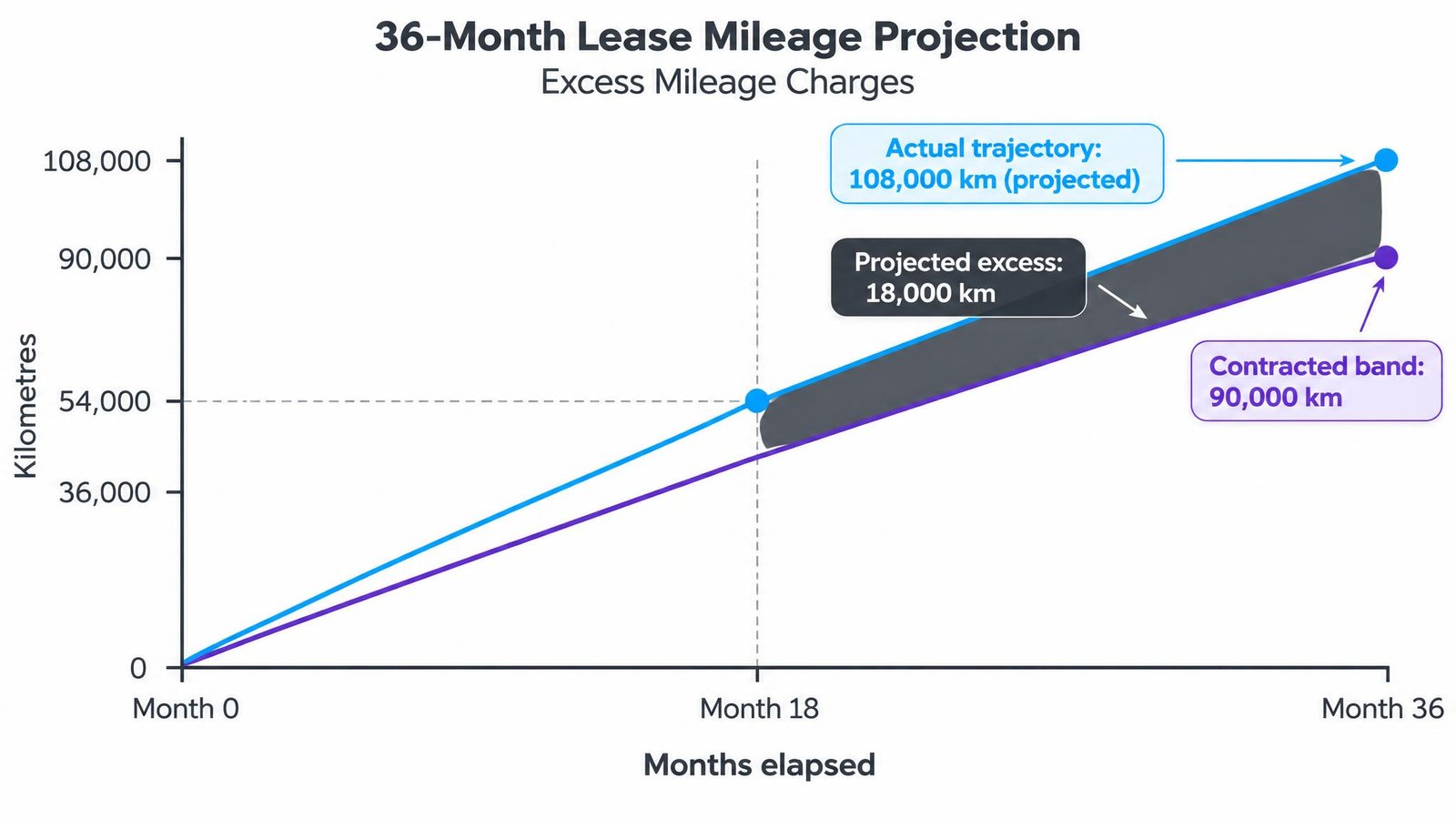
Consider a vehicle contracted over a 36-month term for a total of 90,000 kilometres, implying a monthly run rate of 2,500 kilometres. For illustration, assume the delivery odometer read zero.
At the 18-month review, the recorded odometer shows 54,000 kilometres. The driver has averaged 3,000 kilometres per month, not 2,500. If that rate continues for the remaining 18 months, the vehicle will return at 108,000 kilometres: 18,000 over the contracted band.
This is an illustrative example. The numbers are round to make the arithmetic visible.
At this point, the fleet manager has three options.
The fleet manager in this example identifies the under-tracking vehicle and arranges the swap. Both vehicles finish within their contracted bands.
The projection itself is simple division and multiplication. Its value is the time it creates. At month 18, all three options are open and manageable. By month 33, options narrow: a late amendment or swap may still be possible, but is likely to be less effective or less economical than acting earlier.
Four signals indicate that a vehicle is heading toward an excess mileage charge. Each has a named record source, a specific action and a decision owner.
| Warning sign | Record source | Action | Decision owner |
|---|---|---|---|
| Projected distance exceeds the contracted band at the current run rate | Odometer projection report (calculated from the latest reading and months remaining) | Initiate a projection review; decide between swap, re-contracting or absorption, assessed by materiality of the projected overrun | Fleet manager; escalate within one review cycle if no decision is recorded |
| Driver self-reports have not been received for more than one review period | Driver submission log | Follow up with the driver, or use connected vehicle or telematics data to obtain a current reading; unresolved gaps require attention before an overrun can be confirmed | Fleet manager; escalate if the gap persists beyond a second review period |
| A vehicle has been assigned a new driver with different usage patterns since the last review | Vehicle assignment record | Update the usage profile, re-run the projection with the new driver's expected run rate, and adjust the review cadence if needed | Fleet manager or fleet administrator; complete within one review cycle of the assignment change |
| One vehicle is tracking materially under its contracted band while another is tracking over | Contracted-band comparison report across the portfolio | Assess swap feasibility; screening criteria include policy group compatibility, driver role and remaining term, an opposite-side mileage position is a useful indicator, not a guarantee of suitability | Fleet manager; decision on swap or other action within two review cycles |
The table defines what an exception looks like so that monitoring can be automated and human attention reserved for decisions. Missing readings and changed assignments require attention before an overrun is confirmed, not only after one is projected.
Vehicle swaps. Where fleet policy permits and the vehicles are compatible with both drivers' roles, reallocating vehicles redistributes the remaining distance without changing either contract's allowance. Assign the higher-mileage vehicle to the lower-distance driver, and the lower-mileage vehicle to the higher-distance driver. Evaluate each vehicle's projected final mileage after the swap, alongside operational suitability and any associated costs. An opposite-side mileage position and matching policy groups are useful screening criteria, though meeting both does not automatically make a swap appropriate. A current view of every vehicle's projected contracted position is a prerequisite.
Re-contracting the distance allowance mid-lease. The lessor adjusts the contracted band and recalculates the monthly rental over the remaining term. Judge re-contracting by total incremental cost, not revised monthly payment alone. The full picture includes additional rentals, any applicable fees, possible retrospective adjustments and the expected excess charge avoided. Fewer remaining payments may mean a larger monthly adjustment. Acting earlier gives the lessor more periods over which to distribute the change, but whether this reduces total cost depends on the specific contract terms and the size of the projected overrun.
Increasing the mileage allowance mid-lease is not always possible. Some contracts include a re-contracting provision; others do not. Check this at contract inception, not at the point of needing it.
Absorbing the charge. Sometimes the least disruptive option is to leave the vehicle in place and pay the excess mileage charge at return. This is a legitimate decision. The point is that it is a deliberate choice made with full visibility of the projected charge, not a surprise discovered when the return invoice arrives.
The reverse case: under-mileage. The cost of under-mileage on a lease car is typically paid through the monthly rental, not at the end. A higher contracted allowance produces a lower residual value assumption, which the lessor recovers through a higher monthly payment across the full term. A fleet that contracts for more kilometres than its drivers use pays for those kilometres in every monthly invoice. Some agreements provide under-mileage credits or other adjustments, subject to limits; check the specific contract terms. Where no adjustment applies, under-mileage is a signal that the allowance was over-specified, worth addressing at renewal even if it produces no immediate recovery.

When a lessor prices a lease, the contracted mileage allowance is a key input into the residual value calculation. A car with fewer kilometres is generally worth more at remarketing than one with more. The contracted band tells the lessor how much wear to expect, and the residual value is set accordingly.
The per-kilometre excess rate in the contract is the lessor's mechanism for recovering part of the value shortfall when a vehicle returns with more kilometres than the lease assumed. Excess rates are contractual commercial terms influenced by expected depreciation and other factors; they do not necessarily track the precise marginal change in resale value at each individual kilometre.
Condition compounds the effect. Physical damage assessed beyond the applicable condition standard reduces the vehicle's remarketing value independently of its distance. A car returned with both excess kilometres and condition issues creates a larger combined shortfall than either factor alone.
For the category manager, this connection reframes the prevention argument. Subject to any contractual tolerances or adjustments, every kilometre over the contracted band that is not managed during the lease is a kilometre the lessor will charge for at the rate embedded in the contract.
When the excess mileage invoice arrives at contract end, verify the following:
Where readings or rates are disputed, raise the query with supporting records, the return condition report, any odometer photographs taken at handback, and the signed contract, rather than paying automatically. What to do when a charge does not match the contract is covered in the broader fleet invoice reconciliation discipline.
The charge is generally calculated from the distance travelled during the contract, delivery odometer to return odometer, with any distance above the contracted band multiplied by the per-kilometre rate written into the contract. This gives the gross charge, subject to any tiers, tolerances or contractual adjustments set out in the agreement. Under a standard lease structure, no interim invoice reflects the accumulating exposure during the term, though billing and reconciliation arrangements depend on the specific agreement.
Yes, for some contracts. Some lease agreements include a provision for mid-term re-contracting of the distance allowance. Where it is available, the lessor adjusts the contracted band and recalculates the monthly rental across the remaining term. Not all contracts allow this. Check the terms at inception, not at the point of needing it. When assessing whether to re-contract, model the total incremental cost, including any fees or retrospective adjustments, against the projected excess charge avoided, not the monthly payment movement alone.
No direct charge at return under most standard agreements, but unused mileage is not free. The cost is built into the monthly rental: a higher contracted allowance produces a lower residual value assumption, which the lessor recovers through a higher monthly payment across the full term. Some agreements provide under-mileage credits or adjustments, subject to limits; check the contract. Where no adjustment applies, a vehicle consistently tracking under its band is a sign the allowance was over-specified at inception.
Yes. The contracted mileage allowance is a direct input into the lessor's residual value calculation at the point of pricing the lease. A vehicle returned with more kilometres than contracted is generally worth less at remarketing than the lessor assumed. The per-kilometre excess rate is set to recover part of that shortfall; it is a contractual commercial term influenced by expected depreciation and other factors.

Take the fleet's current contracted-band data and run a projection for every vehicle using the most recent odometer reading, measured from the delivery odometer. The vehicles that surface as likely overruns by contract end are the ones that need a decision this quarter, not at return.
Checking every overrun charge against the contract before it is paid is part of Fleet FinOps: the discipline of identifying, validating, recovering and optimising fleet spend using operational, contractual and financial data.
For fleet managers who want to automate this across the portfolio, the fleet management software page covers how continuous distance monitoring works in practice. Teams that need the monitoring, exception handling and re-contracting support managed end to end can find out more about OviDrive Managed Services.
For savvy fleet managers looking for the latest trends and opportunities to improve their fleet's performance.


Copyright © OviDrive Group of Companies • Made with 💜 in Australia 🦘 • Operating in 36 countries and 3 continents 🌎
