

November 25, 2026
Residual value is the amount a lessor expects a car to be worth at the end of its lease contract. It sets much of the rental because the periodic payment mainly covers the gap between the car's cost at the start and that expected value at the end, plus the cost of finance and any bundled services such as maintenance.
Company cars are not a niche procurement category. Corporate registrations make up about 60% of EU car registrations, a figure the European Parliament Legislative Train confirmed in its October 2026 update. For a category manager or the person running a fleet alongside another job, understanding what residual value is and how it drives the rental is the starting point for controlling what the fleet actually costs.
Residual value helps determine the rental. Separately, agreed mileage and return-condition terms determine potential end-of-contract charges, charges worth checking against the contract before they are paid.
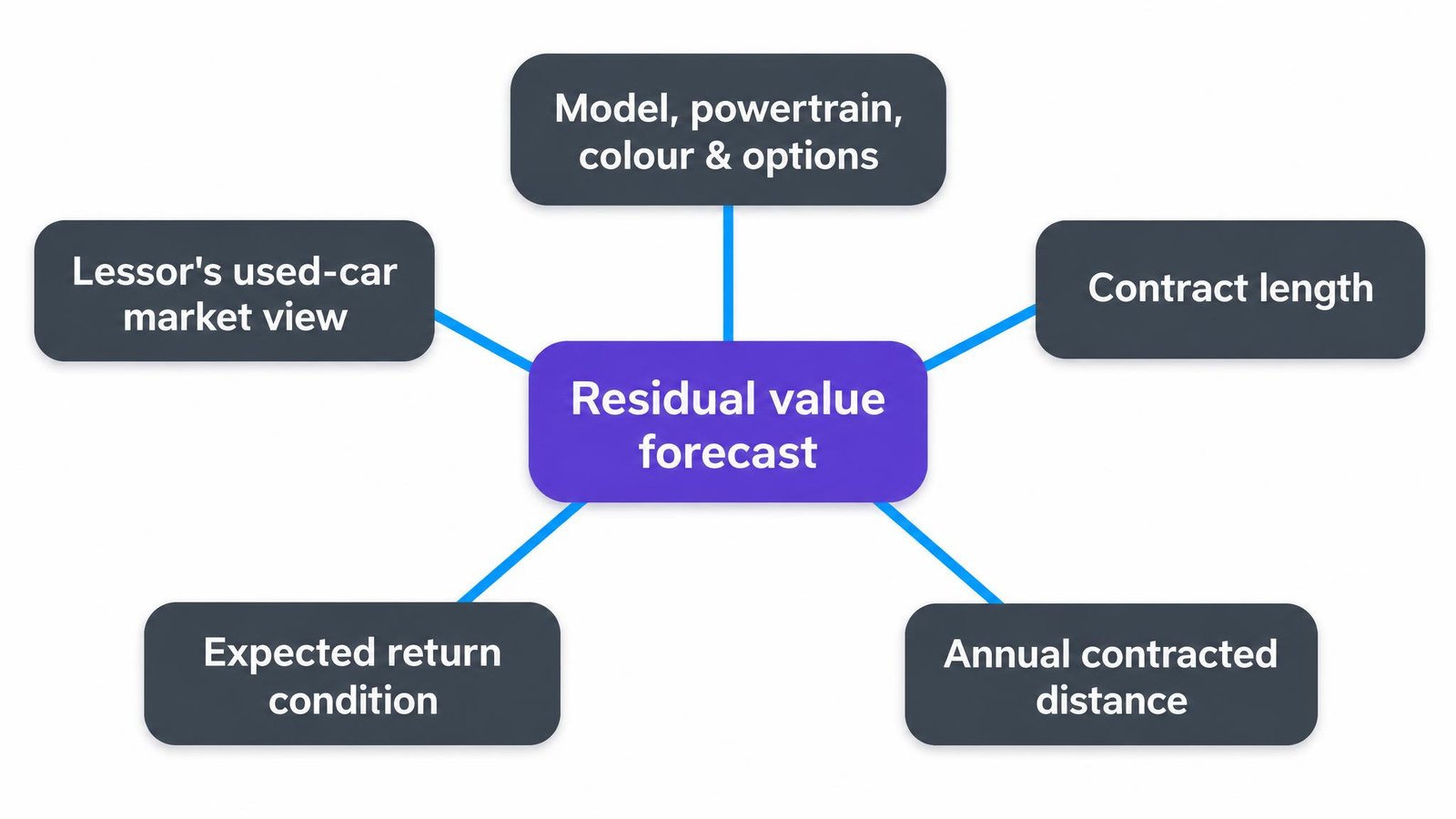
A lessor builds its residual value forecast from five key inputs.
The first is the car itself: model, powertrain, colour and options. A popular mid-specification saloon in a neutral colour has a predictable buyer pool on the used-car market. A niche configuration with a long options list narrows that pool and makes the resale less certain.
The second is contract length. A car returned after 24 months is newer and carries less uncertainty about its used-car value than one returned after 48 months. Shorter contracts generally attract a higher residual value as a percentage of list price.
The third is the annual distance agreed in the contract. Higher contracted kilometres mean more wear and a lower expected value at return.
The fourth is the expected condition at return. The forecast assumes a specified return condition; a vehicle returned below that standard may have a lower actual resale value and attract contractual charges. The condition standard agreed at signing remains fixed; later damage does not change the forecast used to set the rental.
The fifth is the lessor's own view of the used-car market over the contract period. This is a proprietary assessment, not a published figure. Two lessors can look at the same model on the same day and reach different forecasts, because each uses its own data, its own portfolio experience, and its own appetite for risk.
The mechanical link is straightforward. The lessor forecasts what the car will be worth at contract end, subtracts that from the starting cost, and structures the rental to recover the difference plus finance costs and any services. All else being equal, a higher residual value means less depreciation to recover and therefore a lower rental. The lessor also prices market uncertainty into the rental from day one: if used-car values fall below forecast in a standard operating lease, the loss sits with the lessor, not the fleet.
Two lessors quoting on the same vehicle can produce materially different rentals. Residual value assumptions are one reason, but acquisition discounts, funding costs, margins, service scope, fees and commercial strategy all contribute. Comparing quotes without aligning the underlying terms can produce misleading conclusions.
Each lessor uses a proprietary model fed by its own remarketing data, its own portfolio experience, and its own view of the used-car market over the contract period. The outputs diverge because the inputs diverge.
Specification and contract terms raise comparability issues rather than explaining different pricing for identical configurations. Options may add some resale value in absolute terms while recovering only a small share of their original cost, so the retained-value percentage and the depreciation cost can move in opposite directions depending on the option. Contract length matters too: the same car quoted on a 36-month and a 48-month term will carry a different residual value as a percentage of list price, because the forecast horizon is longer and the uncertainty is greater. Because different specifications and contract terms are not identical quotes, apparent rental differences can reflect structural incomparability rather than differing market views.
The practical implication is that a lower rental does not automatically indicate better value. To make a genuine like-for-like comparison across lessors, align each quote on: vehicle specification, contract term and mileage, initial rental, included services, taxes and fees, excess mileage rates, and return condition standards. Once those elements match, compare total contractual cost. Where lessors disclose residual value assumptions, review them as an additional data point.
Fleet choices fall into two distinct categories: those that affect the residual value forecast built into the rental at the point of signing, and those that manage contractual liabilities during and at the end of the contract.
Choices that affect the initial forecast
Model and specification. Models with strong secondary-market demand, neutral colours and standard equipment give the lessor a more predictable resale market to price against. Niche specifications and unusual colours reduce forecast confidence and are typically priced into a higher rental.
Contract length. Shorter contracts generally attract a higher residual value as a percentage of list price because the car is newer and uncertainty is lower. Note that a higher residual percentage does not automatically produce a lower monthly payment: depreciation is recovered over fewer months, so the net effect on the rental depends on the specific term and pricing.
Distance bands. The contracted distance band set too low creates exposure to excess mileage charges at contract end; set too high, it increases the rental unnecessarily. The band should reflect actual driver patterns, not an administrative default.
Choices that manage return liabilities
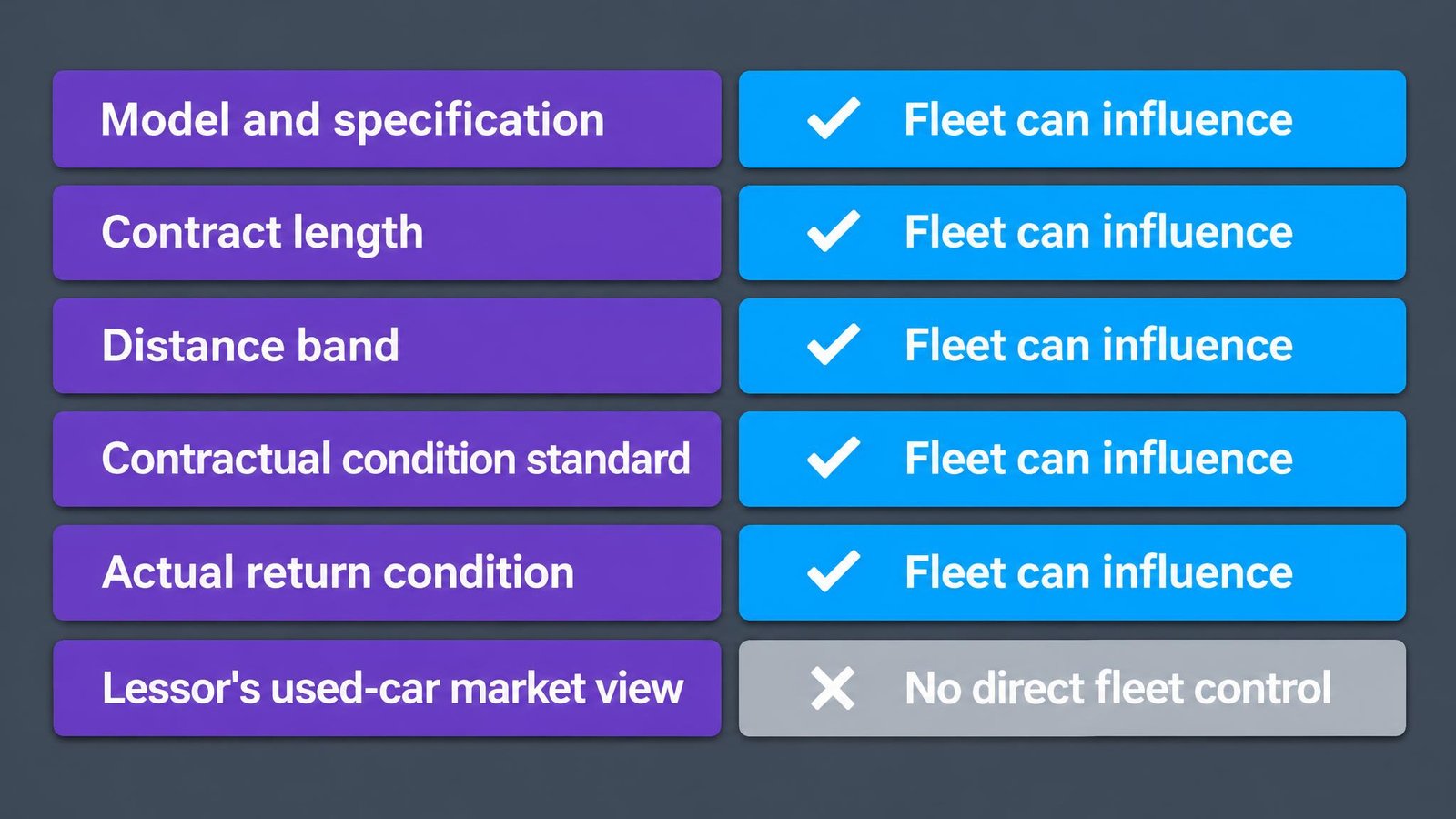
| Factor | Who sets it | Who influences it | Record that shows it |
|---|---|---|---|
| Model and specification | Fleet procurement policy | Fleet (choice of model, colour, options) | Vehicle order records |
| Contract length | Agreed at signing | Fleet policy (replacement cycle) | Lease contract |
| Distance band | Agreed between fleet and lessor | Fleet (based on driver data) | Lease contract (agreed allowance); odometer or telematics records (actual use) |
| Contractual condition standard | Agreed at signing | Fleet (agreed at signing; not changed by subsequent condition) | Lease contract, wear and tear guide |
| Actual return condition | Determined at inspection | Fleet (driver policy, maintenance) | Inspection reports, condition photographs |
| Lessor's view of the used-car market | Lessor only | No direct control | Underlying model usually proprietary; assumptions sometimes disclosed |
The final row is the one input the fleet cannot influence. That is precisely why the other factors matter: they are the levers that shape the forecast before the lessor's market view is applied, and the controls that determine what the fleet pays at return.
In a typical operating lease, the lessor retains ownership of the car and carries the risk that the used-car market at contract end is weaker than forecast. If the car sells for less than the residual value assumed in the rental, the financial shortfall falls on the lessor, not the fleet. The lessor prices this risk into the rental from the outset.
The fleet's contractual exposure at return is separate from residual value risk. It arises from specific obligations agreed in the contract: kilometres above the contracted limit, condition below the agreed standard, missing equipment, service-history gaps, collection arrangements or other items the contract specifies. These liabilities exist independently of whether the lessor achieved its residual value forecast. A compliant return does not create liability for a resale shortfall simply because the used-car market disappointed the lessor; any separately agreed return fees still apply.
Where end-of-contract charges do arise, reconciling them against the original contract terms is a standard component of fleet financial control. That reconciliation tests whether each charge is contractually justified and correctly calculated, not whether the lessor's market forecast proved accurate.
A brief note on lease structures: a finance lease allocates residual value risk differently, and IFRS 16 changed how leases appear on the balance sheet. Both subjects sit outside this article's scope. Local accounting and tax rules vary by country.
Electric vehicles introduce additional residual value uncertainty for lessors. The used-car market for EVs is newer, faster-moving, and more sensitive to subsidy changes, new model releases and charging infrastructure development than the combustion market.
Transport & Environment analysed residual-value data for Germany, France, Italy and Spain from January 2020 to December 2025. In its report What's the situation with RVs in Europe? (September 2026), it found a 12.9 percentage point gap in 2025 between the residual values of petrol and electric cars, which falls to 7.7 points after adjusting for inflation, purchase subsidies and acquisition taxes, and to 2.6 points when used electric cars are compared with current new-car prices. The adjusted and unadjusted figures measure the same observed depreciation gap under different accounting treatments; they are not competing forecasts. The figures reflect a specific set of markets and a specific period.
EV residual assumptions vary by model, market and contract date. Greater uncertainty can increase the risk allowance in a quote, but it does not mean every EV lease will cost more than a comparable combustion-car lease. Acquisition discounts, manufacturer support, funding costs and competition can offset any risk premium. Practical guidance on managing an electric vehicle fleet covers the broader operational considerations.
The lessor expects the car to retain 30% of its original list price at the end of the contract. The rental is structured to recover the remaining 70%, plus the cost of finance and any services included in the agreement. In a standard operating lease, the fleet pays nothing for the vehicle itself at contract end. The lessor sells the car on the used-car market to recover that 30%.
Directly. The rental primarily covers the gap between what the car costs at the start and what the lessor expects it to be worth at the end. All else being equal, a higher residual value means a smaller gap to recover, which produces a lower periodic rental. A lower residual value means a larger gap and a higher rental. Finance costs and bundled services sit on top of that core depreciation charge.
The lessor. If the used-car market at contract end is weaker than the lessor forecast, the financial shortfall falls on the lessor, not the fleet. The fleet's contractual exposure is separate: it covers items the contract specifies, such as kilometres above the contracted limit, condition below the agreed standard, missing equipment or service-history gaps. These are contractual obligations, not a transfer of used-car market losses.
Align each quote on the same vehicle specification, contract term, mileage, initial rental, included services, taxes, fees, excess mileage rates and return condition standards, then compare total contractual cost. A lower monthly figure is not automatically better value; it may reflect a different service scope, term structure or fee arrangement. Where lessors disclose residual value assumptions, review them as an additional data point.
Through the choices it controls during the contract: maintaining cars within the agreed condition standard, tracking distance against the contracted limit, ensuring service history is complete, and understanding the return process and applicable condition guide before the car goes back.
Three actions make the analysis concrete:
Fleet FinOps is the financial management discipline of identifying, validating, recovering and optimising fleet spend using operational, contractual and financial data. The workflow runs Detect, Validate, Draft, Recover, Reconcile: from identifying a potential charge discrepancy, through validating it against the contract, drafting the query to the supplier, recovering the agreed amount, and reconciling the confirmed position in the fleet's financial records. See OviDrive Managed Services, OviDrive Essentials and how OviDrive supports fleet financial control.
For savvy fleet managers looking for the latest trends and opportunities to improve their fleet's performance.


Copyright © OviDrive Group of Companies • Made with 💜 in Australia 🦘 • Operating in 36 countries and 3 continents 🌎
